Panchakarma is the cleansing treatment of Ayurveda. Many people imagine it as a single massage or a “detox”, but it is actually a planned course of treatment, chosen by the doctor for your condition and body type, and done in three stages. Knowing what happens at each stage makes the course easier and more effective.
What does “Panchakarma” mean?
“Pancha” means five and “karma” means action. The five classical procedures are Vamana (therapeutic vomiting), Virechana (purgation), Basti (medicated enema), Nasya (medicine through the nose) and Raktamokshana (blood-letting). Not every patient needs all five. Most patients need one or two, chosen for their problem: Basti for back pain, sciatica and nerve problems; Virechana for skin, liver and digestive problems; Nasya for problems of the head and neck.
Stage 1: Consultation and planning
The doctor asks about your problem, examines you, reviews reports and assesses your Prakriti (body type), digestion and strength. Based on this, you get a written plan: which procedures, which oils and medicines, how many days, and whether you need admission.
Stage 2: Preparation (Purvakarma)
The body is prepared so that the main procedure works safely and fully.
- Snehapana: for Virechana and Vamana, you drink medicated ghee in slowly increasing doses for 3 to 7 days, on an empty stomach.
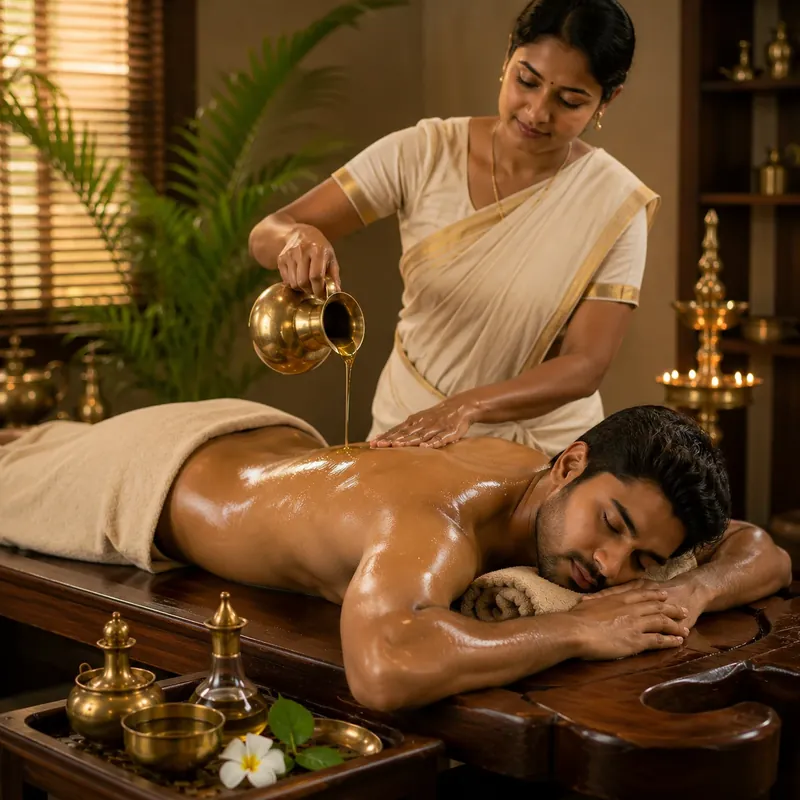
- Abhyanga: warm medicated oil massage of the whole body.
- Swedana: herbal steam, which follows the massage.
During this time you eat light, warm food and avoid heavy, cold and fried food.
Stage 3: The main procedure (Pradhana Karma)
The chosen procedure is done under observation. For Virechana, a herbal purgative is given in the morning and you pass motions several times over the day; staff check your pulse, BP and comfort. Basti is given as a series, for example 8, 16 or 30 days, alternating oil and decoction enemas. Nasya is usually a 7-day course. Most patients find these procedures much easier than they expected.
Stage 4: Recovery diet (Paschat Karma)
After cleansing, digestion is weak for a few days. It is rebuilt step by step with Samsarjana Krama: thin rice gruel first, then thicker gruel, then khichdi, then normal food. Following this diet properly is one of the most important parts of the whole course.
How long does Panchakarma take?
Most courses take 7 to 21 days. Some local therapies can be done as daily OPD visits of about an hour. Longer courses, Virechana and treatment under cashless insurance usually need admission.
Who should not take Panchakarma?
Most cleansing procedures are avoided in pregnancy, during acute fever or infection, and in very weak or frail patients. The doctor checks this before planning your course.
Tips for a good course
- Follow the diet exactly, including during the recovery days
- Avoid travel, late nights, cold water and exercise that tires you
- Tell the doctor about every medicine you take
- Rest between therapies
Panchakarma at Keshavbaug
At Keshavbaug, Panchakarma is planned by our doctors and given by trained therapists in our NABH-accredited hospital. Many health insurance policies cover in-patient Panchakarma for medical conditions; our desk checks your policy before admission.
Written by the doctors of KeshavbaugThis article is for general information and is not a substitute for a consultation. Please see a doctor before starting any treatment.